FibreSeeker 3 Brings Continuous Fibre 3D Printing to the Desktop
FibreSeeker 3 Brings Continuous Fibre 3D Printing to the Desktop
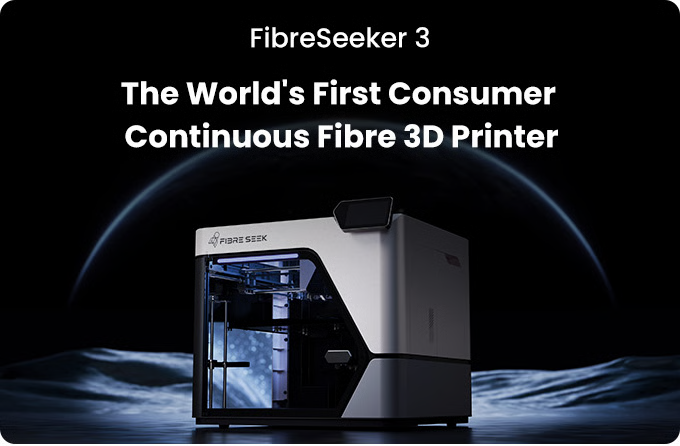
Desktop 3D printers have become faster, more accurate and considerably easier to use, but the strength of conventional FDM parts can still limit their practical applications. While standard thermoplastics work well for models, prototypes and many everyday components, they may not provide the stiffness or load-bearing performance required for demanding functional parts.
The FibreSeeker 3 has been developed to address this limitation by bringing continuous fibre reinforcement to a more accessible desktop system. Created by FibreSeek, the printer combines conventional polymer extrusion with continuous carbon or glass fibre, allowing reinforcement to be placed within selected areas of a printed component.
Following a successful Kickstarter campaign, the FibreSeeker 3 received support from 1,539 backers and raised more than $4.69 million against its original $50,000 target. FibreSeek describes it as the first consumer continuous fibre 3D printer, positioning the machine between conventional desktop FDM printers and significantly more expensive industrial composite systems.
What Is Continuous Fibre 3D Printing?
Most carbon-fibre filaments used by desktop 3D printers contain short, chopped fibres mixed into a thermoplastic. These materials can improve stiffness, dimensional stability and surface finish, but the individual fibres remain relatively short and cannot carry loads throughout the complete part.
Continuous fibre printing works differently. Long strands of reinforcing fibre are placed inside the component as it is printed, creating a composite structure. The principle is similar to using steel reinforcement inside concrete: the surrounding polymer forms the shape of the part, while the continuous fibres strengthen the areas that must withstand higher loads.
FibreSeek calls its process Continuous Fibre Co-extrusion, or CFC. The FibreSeeker 3 can use continuous carbon fibre or continuous glass fibre alongside a selection of conventional and engineering-grade thermoplastics. Users can also control the orientation and placement of the fibre reinforcement to suit the forces that the finished component is expected to experience.
Three Printing Modes for Different Applications
The FibreSeeker 3 is not limited to continuous fibre printing. Its three printing modes allow it to operate as a conventional FDM printer, manufacture fibre-reinforced components or combine different materials within the same project.
- FDM printing: Produces conventional thermoplastic parts without continuous reinforcement.
- Continuous fibre printing: Adds carbon or glass fibre reinforcement to improve strength and stiffness.
- Multi-material printing: Combines different compatible materials to create parts with more specialised properties.
This flexibility means continuous reinforcement does not have to be used throughout every model. It can instead be reserved for functional components and strategically applied to the areas where additional strength is genuinely required.
Designed for Stronger Functional Parts
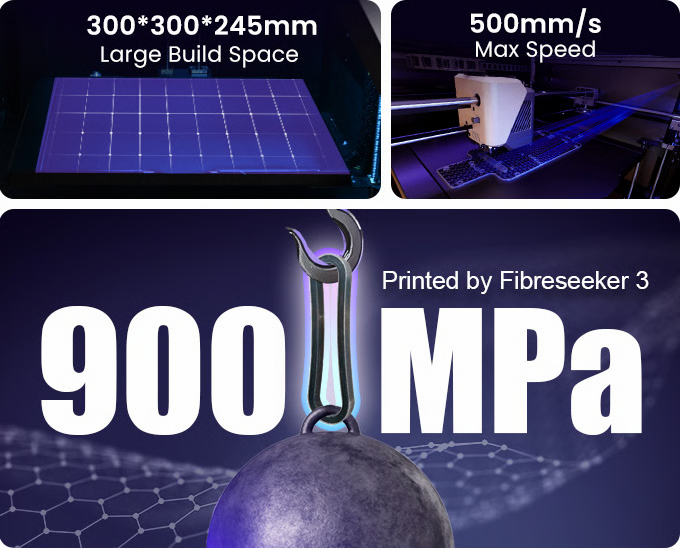
According to FibreSeek, reinforced components can achieve tensile strength of up to 900 MPa and be up to ten times stronger than comparable parts made using standard plastics. Actual performance will depend on several factors, including the base polymer, reinforcement material, fibre orientation, part geometry and print settings.
The main advantage is the ability to manufacture components that are both strong and lightweight. This makes the technology particularly interesting for robotics, drones, automotive development, engineering tools, brackets, jigs, fixtures and other applications where a conventional plastic component may bend or break under load.
It could also allow designers to test functional prototypes more realistically. Rather than using a basic plastic model to confirm only the shape and fit of a design, continuous fibre reinforcement can help produce a prototype that is capable of undergoing more representative mechanical testing.
FibreSeeker 3 Technical Specifications
The FibreSeeker 3 offers a 300 × 300 × 245 mm build volume, providing enough capacity for engineering prototypes, tooling and small production components. Conventional FDM printing can reach speeds of up to 500 mm/s, while the stated continuous fibre deposition rate is up to 20 cm³ per hour.
- Build volume: 300 × 300 × 245 mm
- Maximum FDM printing speed: Up to 500 mm/s
- Continuous fibre deposition rate: Up to 20 cm³ per hour
- Minimum layer height: 0.05 mm
- Stated accuracy: ±0.2 mm
- Maximum nozzle temperature: 320°C
- Maximum heated bed temperature: 110°C
- Build plate levelling: Automatic
- Interface: 5-inch touchscreen
- Monitoring: Integrated HD camera
The listed polymer compatibility includes PLA, PETG, polycarbonate, nylon, carbon-fibre-reinforced nylon and glass-fibre-reinforced PETG. FibreSeek has also developed its own X-CCF continuous carbon fibre and X-CGF continuous glass fibre reinforcement materials for the CFC printing process.
Monitoring and Fibre Management
Continuous fibre printing introduces additional considerations beyond those found on a normal FDM printer. Fibre tension, placement and uninterrupted material flow all affect the quality and mechanical performance of the finished component.
To help manage this, the FibreSeeker 3 includes fibre tension monitoring, vibration compensation and sensors designed to detect filament breaks or fibre blockages. An integrated HD camera also allows users to monitor a print remotely, which is particularly useful for longer engineering and composite printing jobs.
Models are prepared using FibreSeek Aura, the company’s dedicated slicing software for Windows and macOS. The software supports STL, STP and 3MF files and provides control over the placement and orientation of the reinforcing fibres within the part.
Who Is the FibreSeeker 3 For?
Although FibreSeek describes the machine as a consumer 3D printer, its greatest value is likely to be found among engineers, product designers, universities, research departments, technical educators and small manufacturers. These users may already understand FDM printing but require components with greater strength and stiffness than conventional thermoplastics can provide.
Potential applications include lightweight drone frames, robot components, automotive prototypes, sports equipment, gears, brackets, manufacturing aids and replacement parts. It may also provide educational institutions with a more accessible way to demonstrate composite manufacturing and fibre orientation without investing in a large industrial system.
A More Accessible Route into Composite Manufacturing
The FibreSeeker 3 represents an interesting step in the development of desktop additive manufacturing. Rather than focusing solely on faster printing or additional material colours, it attempts to improve the mechanical capabilities of the finished component.
Continuous fibre 3D printing will not replace every conventional FDM process, and many models will not require this level of reinforcement. However, for applications where weight, stiffness and load-bearing performance matter, the ability to add continuous carbon or glass fibre could considerably expand what can be manufactured on a desktop machine.
By combining conventional FDM printing, multi-material capabilities and continuous fibre reinforcement within one system, the FibreSeeker 3 aims to make composite part production available to a much wider range of designers, engineers and organisations.