
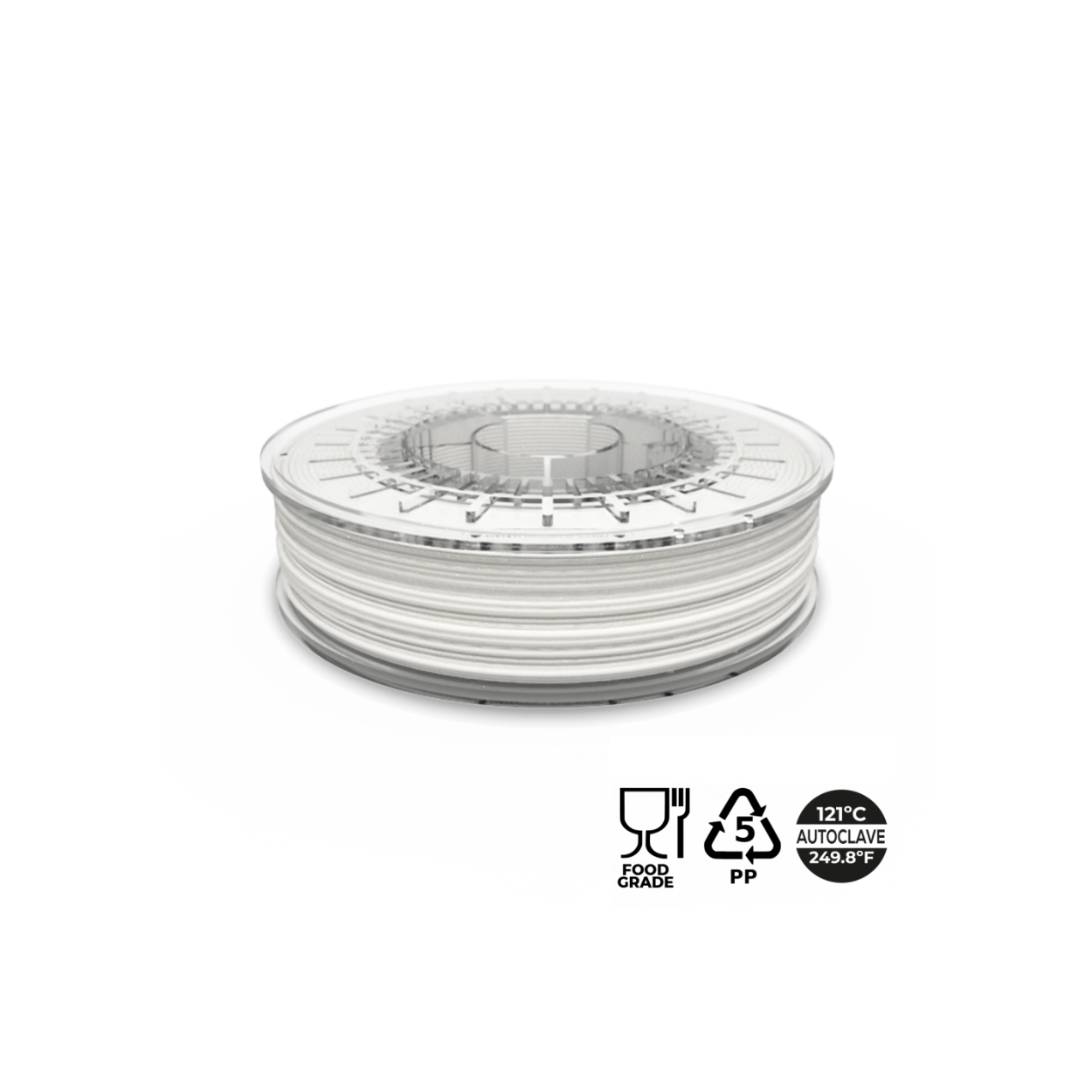
Recreus PP3D Polypropylene Filament - 600g
Recreus PP3D – Engineering Polypropylene Filament with Dedicated Primer
Recreus PP3D is a specialist polypropylene filament developed for functional 3D printed parts requiring chemical resistance, high fatigue resistance, low weight, toughness and low friction.
Developed by Recreus in collaboration with Repsol, PP3D provides the characteristic engineering advantages of polypropylene while addressing one of the material’s traditional challenges in FDM printing: reliable build-platform adhesion.
Each spool is supplied with a dedicated PP3D adhesion primer, helping provide strong adhesion to a clean glass build surface at a bed temperature of approximately 40°C.
PP3D is particularly suited to functional prototypes and end-use components such as living hinges, snap-fit parts, chemical-resistant components, containers, lightweight mechanical parts and production-intent polypropylene prototypes.
This product listing is for Natural PP3D, 1.75 mm diameter, supplied on a 600 g spool.
PP3D at a Glance
| Material | Polypropylene (PP) |
| Best For | Functional parts, living hinges, chemical-resistant components and polypropylene prototypes |
| Colour | Natural |
| Diameter | 1.75 mm |
| Net Weight | 600 g |
| Build Adhesion | Dedicated PP3D Primer supplied |
Compliance & Manufacture


Key Performance Benefits
- Excellent fatigue resistance: Particularly well suited to parts designed to bend, flex or move repeatedly.
- High chemical resistance: Polypropylene offers resistance to a broad range of chemicals, making PP3D useful for industrial and fluid-handling applications.
- Low density: Suitable for producing lightweight functional components.
- Low friction: Useful for moving components and applications where reduced surface friction is desirable.
- High toughness and impact performance: More suitable for demanding functional applications than rigid, brittle desktop materials.
- Strong interlayer adhesion: Helps produce durable functional components when correctly processed.
- Primer-assisted printing: The supplied adhesion primer helps overcome the build-surface adhesion challenges normally associated with polypropylene.
- Professional matte finish: PP3D produces a smooth surface with an injection-moulded-style appearance that can make layer transitions less visually prominent.
Why Choose PP3D Polypropylene?
Choose PP3D when you need the functional properties of genuine polypropylene but want a material system specifically developed to make PP more practical for FDM 3D printing.
- Excellent resistance to repeated flexing and fatigue
- Strong chemical resistance
- Lightweight, low-density polymer
- Low friction coefficient
- Suitable for living hinges and snap-fit components
- Dedicated PP3D adhesion primer supplied
- Injection-moulded-style matte surface finish
- Ideal for production-intent polypropylene prototypes
Why 3D Print with Polypropylene?
Polypropylene is one of the world’s most widely used thermoplastics and is commonly found in packaging, containers, automotive components, laboratory products, household goods and injection-moulded engineering parts.
Its combination of low density, chemical resistance, toughness and fatigue resistance makes it particularly useful for functional components that need to behave differently from conventional PLA or PETG.
One of polypropylene’s most distinctive properties is its ability to tolerate repeated flexing. This makes PP particularly suited to designs incorporating living hinges, flexible closures, clips and snap-fit features.
Typical Applications
- Living hinges and flexible closures
- Snap-fit components and clips
- Functional engineering prototypes
- Lightweight mechanical components
- Chemical-resistant parts
- Bottles, containers and fluid-handling prototypes
- Low-friction components
- Industrial tooling and fixtures
- Electrical insulation components
- Laboratory and technical components
- Automotive-style functional prototypes
- Production-intent polypropylene prototypes
Prototype in Polypropylene Before Production
Many commercial products are ultimately manufactured from polypropylene by injection moulding. Printing prototypes in PP3D allows designers and engineers to evaluate a component using the same broad polymer family as the intended production material, rather than evaluating the design exclusively in PLA or PETG.
This can be particularly valuable when assessing features such as living hinges, snap fits, flexibility, weight, surface feel and chemical compatibility before investing in production tooling.
Chemical Resistance & Functional Use
Polypropylene is widely selected for applications where resistance to chemicals, oils and industrial fluids is required. Recreus highlights PP3D for applications involving a broad range of acids, bases, solvents, greases, oils and cleaning products.
This makes the material particularly interesting for containers, laboratory components, industrial fixtures and fluid-handling prototypes.
PP3D Primer – Solving the Polypropylene Adhesion Challenge
Polypropylene naturally has a low surface energy, which can make reliable adhesion to conventional 3D printer build surfaces difficult.
PP3D is therefore supplied as a material system incorporating a dedicated Recreus PP3D Primer. When correctly applied to a clean glass build surface, the primer provides strong adhesion at a bed temperature of approximately 40°C.
Basic Primer Procedure
- Apply an even layer of PP3D Primer to the required area of a clean glass build plate.
- Allow the primer to dry for at least approximately 5 minutes.
- Set the build-plate temperature to 40°C.
- Print the PP3D component using appropriate polypropylene settings.
- After printing, Recreus recommends heating the glass bed to approximately 85°C to assist part removal.
Recommended Starting Print Settings
| Material | Polypropylene (PP) |
| Filament Diameter | 1.75 mm |
| Net Weight | 600 g |
| Colour | Natural |
| Starting Nozzle Temperature | Approximately 230°C |
| Build Plate | Clean glass + PP3D Primer recommended |
| Bed Temperature | 40°C with PP3D Primer |
| Removal Temperature | Approximately 85°C on glass with PP3D Primer |
| Typical Layer Height | 0.20 mm starting point |
| Nozzle | Standard brass nozzle suitable |
| Cooling | Minimal cooling recommended; avoid cooling on the first layer |
Material Storage & Drying
For consistent extrusion and surface quality, PP3D should be stored sealed and protected from moisture when not in use.
If moisture-related printing problems are suspected, Recreus recommends drying the filament at approximately 50°C. Drying time will depend on the condition of the material and storage environment.
Printer Compatibility
Recreus PP3D is suitable for open-material FDM / FFF printers using 1.75 mm filament that can operate at the required extrusion temperature.
A specialist hardened nozzle is not required. Recreus states that a standard brass nozzle is suitable.
Typical compatible open-material platforms may include suitable models from:
- Bambu Lab
- Prusa Research
- Raise3D
- Creality
- WASP
- UltiMaker models supporting suitable third-party filament workflows
- Other compatible 1.75 mm open-material FDM / FFF printers
PP3D vs PLA and PETG
PP3D is not intended simply as a premium replacement for PLA or PETG. Polypropylene is normally selected when the functional behaviour of the material itself is important.
| Requirement | PLA | PETG | PP3D |
|---|---|---|---|
| General printability | Very easy | Easy | More specialised / primer-assisted |
| Repeated flexing | Limited | Moderate | Excellent |
| Living hinges | Poor choice | Limited | Well suited |
| Chemical resistance | Application dependent | Good | Key PP advantage |
| Low-density lightweight parts | Good | Moderate | Excellent |
| Production PP prototyping | Different polymer | Different polymer | Same broad polymer family |
Food-Contact & Autoclave Applications
Recreus identifies PP3D as suitable for food-contact and autoclavable applications. These characteristics can make Natural PP3D particularly interesting for specialist laboratory, food-industry and technical applications.
However, material suitability and finished-part suitability are not necessarily the same thing. The 3D printing process can introduce additional variables including surface porosity, printer cleanliness, nozzle contamination and processing conditions.
Frequently Asked Questions
What is PP3D polypropylene filament?
PP3D is an engineering polypropylene filament developed by Recreus in collaboration with Repsol. It is designed for functional 3D printing applications requiring polypropylene properties such as chemical resistance, low density, toughness and fatigue resistance.
What size and colour is this PP3D filament?
This Daemon 3D Print listing is for Natural PP3D, 1.75 mm diameter, supplied on a 600 g spool.
Does PP3D come with the adhesion primer?
Yes. The PP3D system includes Recreus’ dedicated adhesion primer, designed to provide strong polypropylene adhesion to a suitable clean glass build surface at approximately 40°C.
Why is polypropylene difficult to 3D print?
Polypropylene has low surface energy and naturally adheres poorly to many conventional build surfaces. It can also shrink as it cools. PP3D addresses the adhesion challenge through its dedicated primer and recommended printing procedure.
Can PP3D be used for living hinges?
Yes. Polypropylene’s excellent resistance to repeated flexing makes it particularly well suited to living hinges, flexible closures, clips and similar features when the part is designed and printed appropriately.
Is PP3D chemically resistant?
Polypropylene offers strong resistance to a broad range of chemicals and industrial fluids. Compatibility nevertheless depends on chemical type, concentration, temperature and exposure duration, so critical applications should always be tested.
Can PP3D be used to print watertight containers?
PP3D is well suited to container and fluid-handling prototypes, and suitably printed components may achieve very low permeability or watertight performance. However, watertightness depends on wall thickness, extrusion settings, geometry and print quality and should be tested for the intended application.
Is PP3D suitable for food-contact applications?
Recreus identifies PP3D as suitable for food-contact applications. The suitability of a finished 3D printed component also depends on the printer, nozzle, processing conditions, cleanliness, surface structure and intended use, so finished parts should be validated where required.
Can Natural PP3D be autoclaved?
Recreus identifies PP3D as autoclavable. For applications involving sterilisation, the printed geometry, wall thickness, print orientation and intended autoclave cycle should be validated before the component is placed into service.
Does PP3D need a hardened nozzle?
No. PP3D is not a fibre-reinforced abrasive filament, and Recreus states that a standard brass nozzle is suitable.
Which 3D printers can print PP3D?
PP3D can be used with suitable open-material FDM / FFF printers accepting 1.75 mm filament and capable of the required extrusion temperature. Correct primer use, build-surface preparation and protection from drafts are particularly important when printing polypropylene.
What build surface should I use?
Recreus recommends a clean glass build surface used with the dedicated PP3D Primer. The recommended bed temperature with the primer is approximately 40°C.
Why is the bed heated to around 85°C after printing?
Recreus recommends increasing the temperature of the glass build plate to approximately 85°C after printing to help release the finished PP3D component from the primer-coated surface.
Should PP3D be dried before printing?
Keep PP3D sealed and dry during storage. If moisture-related extrusion or surface-quality problems appear, Recreus recommends drying the material at approximately 50°C before printing.
Why choose PP3D instead of PLA or PETG?
PP3D is normally chosen where the specific properties of polypropylene matter, particularly repeated flexing, living hinges, low density, low friction and chemical resistance. PLA and PETG are generally easier to print but do not provide the same combination of polypropylene characteristics.
Is PP3D suitable for production-intent prototypes?
Yes. When the eventual production component will be made from polypropylene, PP3D allows designers to evaluate a prototype using the same broad polymer family rather than relying only on PLA or PETG.
| Material | Polypropylene |
|---|---|
| Technical Specifications | Recommended Print Parameters
|
What's in the Box
- 1 x Recreus PP3D Polypropylene Filament - 600g
