
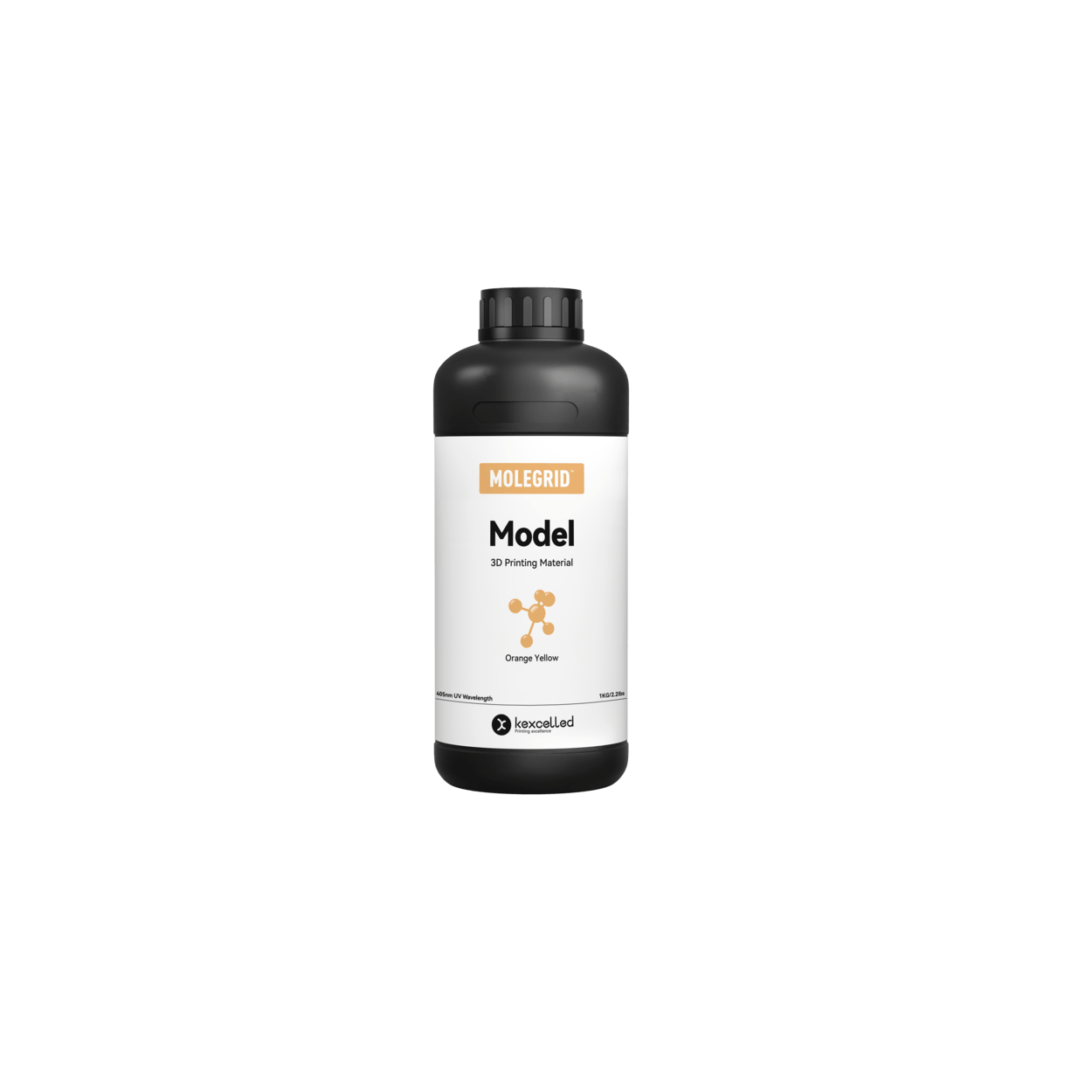
Kexcelled MOLEGRID™ Model Professional Dental Resin - 1 kg
Kexcelled MOLEGRID™ Model is a professional 385–405 nm dental model resin developed for accurate crown and bridge, orthodontic, diagnostic and aligner-production models. Its low shrinkage, rigid mechanical properties and matte finish support fine detail inspection, reliable handling and consistent laboratory workflows. With an indicated practical yield of approximately 32 models per 1 kg bottle, it offers dental laboratories a competitive cost per successful model and strong return on material investment.
Professional Dental Model Resin for Accurate, Cost-Efficient Production
Kexcelled MOLEGRID™ Model Dental Resin is a professional 385–405 nm photopolymer developed for dental laboratories, orthodontic workflows and in-house dental model production.
Its low shrinkage, dimensional stability and matte surface finish support the production of detailed working models for crown and bridge applications, orthodontics, aligner thermoforming, diagnostic work and dental education.
With an indicated practical yield of approximately 32 models from a 1 kg bottle, depending on model geometry and print strategy, MOLEGRID™ Model helps laboratories assess material value through the cost per successful model rather than bottle price alone.
Key Performance Benefits
- Dimensional accuracy: Low cure shrinkage helps preserve dental anatomy, preparation margins and overall model geometry.
- Matte Grey and Beige finishes: Both colour options reduce visual glare and make preparation boundaries, surface detail and dental anatomy easier to inspect under laboratory lighting.
- Fine detail reproduction: Controlled viscosity supports effective resin flow and the reproduction of detailed dental features.
- Rigid, durable models: The resin’s hardness and flexural properties support routine handling, trimming, articulation and suitable thermoforming workflows.
- Practical material efficiency: Designed to support reliable printing, effective drainage and lower material consumption per successful model.
Designed for Dental Laboratory Workflows
Crown, Bridge and Removable Die Models
Low shrinkage and dimensional stability help produce working models and removable dies with clearly defined preparation margins. The opaque matte surface also supports visual inspection, manual finishing and wax-up procedures.
Orthodontic and Aligner Models
The combination of rigidity, flexural strength and thermal resistance makes MOLEGRID™ Model suitable for appropriately validated vacuum-forming and pressure-forming workflows. Processing conditions should be confirmed for the specific printer, model design, forming material and thermoforming equipment being used.
Diagnostic and Educational Models
Produce detailed, professional models for diagnostic work, case planning, patient communication, laboratory reference and dental teaching environments.
More Models from Every Bottle
Assess the Cost per Successful Model
Resin value should not be judged only by the purchase price of the bottle. For a working dental laboratory, the more useful comparison is the cost per accurate and successfully printed model.
This calculation should account for model volume, supports, vat residue, cleaning losses, printer calibration and any repeated jobs.
- Indicated practical yield: Approximately 32 full models per 1 kg bottle.
- Indicative cost calculation: Divide the current bottle price excluding VAT by 32 to estimate the approximate material cost per model.
- Commercial benefit: Consistent printing and dimensional stability can help reduce wasted material, repeated jobs and unnecessary technician time.
Factors That Affect Actual Yield
- Model size and geometry
- Solid or hollow construction
- Wall thickness and drainage-hole design
- Orientation and support requirements
- Resin remaining on the build platform or in the vat
- Printer calibration and first-time print success
Actual output will vary between laboratories. The stated yield should therefore be treated as an indicative production benchmark rather than a guaranteed number of models.
Volume Pricing for Regular Users
Dental laboratories with regular production requirements can access dedicated webshop pricing when purchasing 10 bottles or 20 bottles. The applicable volume discount is displayed automatically through the product pricing options on this page.
These quantity breaks allow growing laboratories to reduce their bottle cost while maintaining access to the same professional dental material and UK-based technical support.
Technical Specifications
| Technical Property | Value | Practical Relevance |
|---|---|---|
| Wavelength range | 385–405 nm | Suitable for many open-material LCD, MSLA and DLP printers operating within this wavelength range. |
| Resin viscosity | 300–400 mPa·s at 25°C | Supports resin flow, layer replenishment and post-print drainage. |
| Liquid density | 1.10–1.20 g/cm³ at 25°C | Provides a reference for material handling and production calculations. |
| Tensile strength | 42 MPa — ASTM D638 | Contributes to model durability during normal handling. |
| Tensile modulus | 2,480 MPa — ASTM D638 | Indicates material stiffness and resistance to tensile deformation. |
| Elongation at break | 13% — ASTM D638 | Indicates the material’s balance between rigidity and limited deformation before failure. |
| Flexural strength | 68 MPa — ASTM D790 | Supports handling, trimming and suitable thermoforming operations. |
| Flexural modulus | 1,900 MPa — ASTM D790 | Helps models retain their shape under bending loads. |
| Impact strength | 30 J/m — ASTM D256 | Provides an indication of resistance to sudden impact. |
| Shore hardness | 84 Shore D — ASTM D2240 | Provides a hard surface suited to detailed working models. |
| Heat deflection temperature | 68.9°C at 0.45 MPa — ASTM D648 | Supports use in appropriately validated thermoforming workflows. |
| Post-curing reference | 10 minutes at 10 mW/cm² | Reference curing condition used to achieve the stated material properties. |
| Available colours | Grey and Beige | Matte colour options help reduce glare and improve visual assessment of margins and surface detail. |
Technical documentation: The official product brochure and Technical Data Sheet are available through the Attachments tab on this product page.
Dental Applications
- Full-arch dental models
- Models with removable dies
- Crown and bridge working models
- Orthodontic study models
- Aligner and retainer production models
- Diagnostic models
- Educational and demonstration models
Recommended Processing Workflow
- Mix: Shake or mix the resin thoroughly before use to redistribute any settled pigment.
- Print: Use suitable starting parameters for the printer’s wavelength, light source and layer height. Validate settings before production use.
- Wash: Clean the printed models using the method and solvent specified in the current manufacturer documentation.
- Dry: Allow the model to dry completely before post-curing.
- Post-cure: Follow the manufacturer’s stated curing conditions to achieve the published mechanical properties.
Processing requirements may vary according to the printer, wash equipment, curing chamber, model geometry and laboratory environment.
Storage and Safe Handling
- Keep the bottle tightly closed when not in use.
- Store in accordance with the temperature range stated in the current technical documentation.
- Protect the resin from sunlight, UV exposure and excessive heat.
- Wear suitable protective gloves and eye protection when handling uncured resin.
- Read the current Safety Data Sheet before use.
- Keep away from children and unauthorised personnel.
Why Buy from Daemon 3D Print?
- UK-based supply: Local availability and support for professional dental, educational and laboratory customers.
- Technical guidance: Assistance with printer compatibility, starting parameters and workflow considerations.
- Volume pricing: Dedicated webshop discounts are available for purchases of 10 bottles and 20 bottles.
- B2B procurement support: Formal quotations, invoicing and purchasing support for dental laboratories, clinics, universities and other organisations.
Frequently Asked Questions
Is MOLEGRID™ Model compatible with 405 nm 3D printers?
It is formulated for light sources within the 385–405 nm range. Compatibility also depends on whether the printer accepts third-party materials and provides sufficient control over exposure settings.
Which printer brands can use this resin?
It may be suitable for many open-material LCD, MSLA and DLP systems operating at 385–405 nm. Compatibility and starting settings should be confirmed for the specific printer model.
Which colours are available?
MOLEGRID™ Model is available in matte Grey and Beige. Both options are intended to reduce visual glare and support the inspection of dental anatomy and preparation margins.
How many dental models can be printed from one bottle?
The indicated practical yield is approximately 32 models from a 1 kg bottle. Actual yield depends on model size, hollowing, wall thickness, orientation, supports and production losses.
How do I calculate the approximate resin cost per model?
Divide the current bottle price excluding VAT by the expected practical yield. Using 32 models as an indicative benchmark provides a simple estimated material cost per model.
Are volume discounts available?
Yes. Dedicated webshop discounts are available for purchases of 10 bottles and 20 bottles. The relevant price break is shown through the product pricing on this page.
Is it suitable for clear-aligner thermoforming?
The resin’s published thermal and flexural properties support suitable thermoforming applications. The complete workflow should still be validated using the laboratory’s own forming temperature, pressure, model design and equipment.
Can it be used for direct patient contact?
No direct intraoral use should be assumed. MOLEGRID™ Model is intended for physical working models and thermoforming formers, rather than dental appliances placed directly in the mouth.
Why does the resin have a matte finish?
The matte, opaque finish reduces visual glare and helps make surface anatomy, preparation boundaries and margin details easier to inspect under laboratory lighting.
Does the resin require washing and post-curing?
Yes. Printed models must be properly cleaned, fully dried and post-cured according to the current manufacturer instructions.
Where can I find the Technical Data Sheet and brochure?
The official Technical Data Sheet and product brochure are available in the Attachments tab on this product page.
Can Daemon 3D Print assist with starting settings?
Daemon 3D Print can provide available starting guidance for compatible open-material printers. Final settings should be validated by the user before production work.
How should the resin be stored?
Keep it in its original closed container, protected from sunlight, UV exposure and heat. Follow the current Technical Data Sheet and Safety Data Sheet for the specified storage temperature and handling requirements.
What's in the Box
- 1 x Kexcelled MOLEGRID™ Model Professional Dental Resin - 1 kg
