
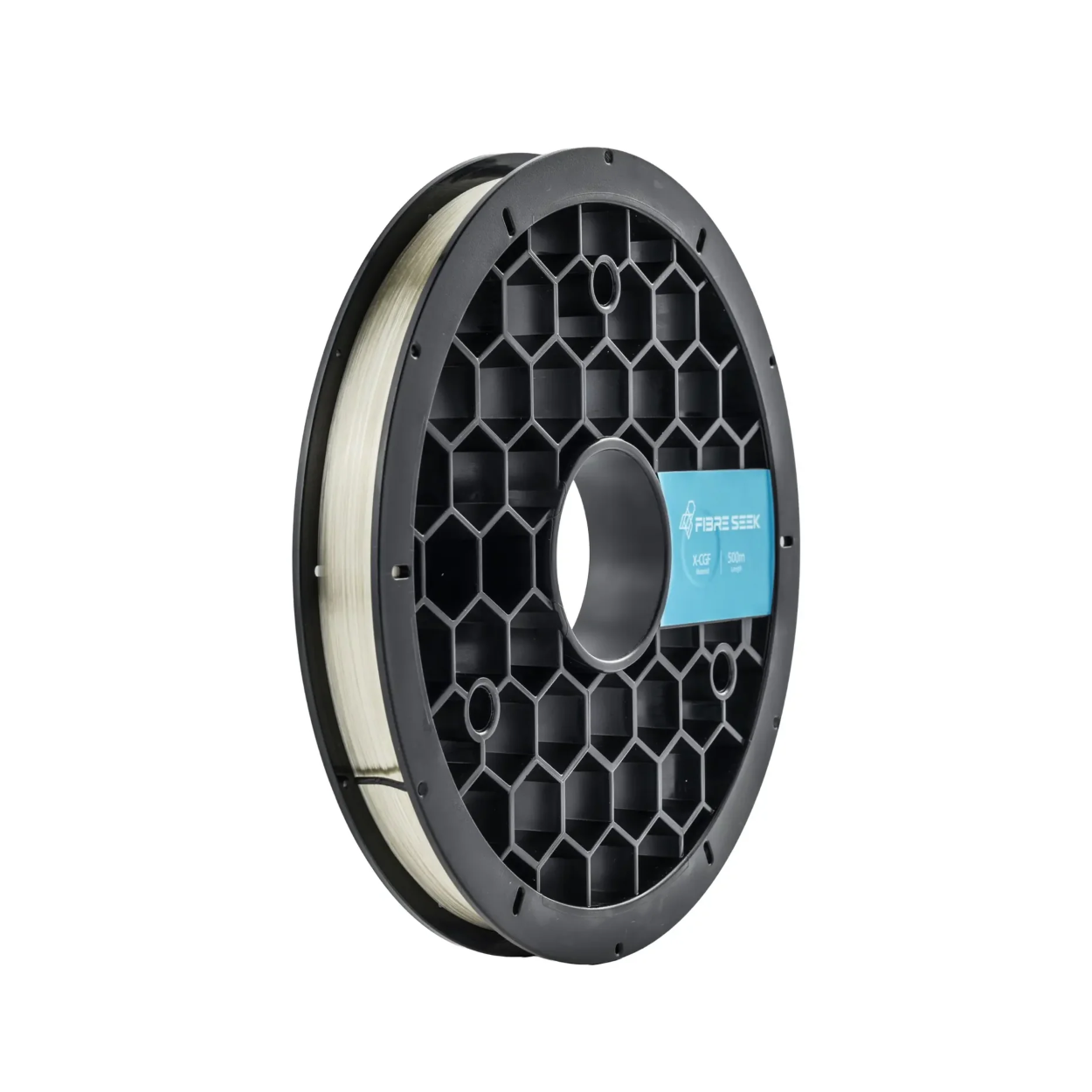
FibreSeek X-CGF Continuous Glass Fibre
FibreSeek X-CGF Glass Fiber Filament
FibreSeek X-CGF is a continuous glass fibre reinforcement material developed for Composite Fibre Co-extrusion (CFC) printing with the FibreSeeker 3. Rather than using short chopped glass fibres mixed into a conventional thermoplastic filament, X-CGF provides a continuous glass fibre path through the printed component.
X-CGF is designed to increase tensile performance, toughness and impact resistance while retaining the electrically insulating properties associated with glass fibre. This makes it particularly useful for reinforced parts used around electronics, communications equipment and applications where electrically conductive carbon fibre may not be appropriate.
The material is intended for functional engineering components, impact-resistant parts, tooling, jigs, fixtures, structural prototypes and other applications where continuous reinforcement is required without the electrical conductivity of carbon fibre.
Key Benefits of X-CGF Continuous Glass Fibre
- Continuous glass fibre reinforcement: Uses a full-length reinforcement strand rather than short chopped fibres dispersed through a thermoplastic.
- High tensile strength: Manufacturer TDS testing records tensile strength of up to 714 ± 165 MPa when X-CGF is combined with CFC PLA.
- Impact-resistant reinforcement: Glass fibre is well suited to applications where toughness and resistance to impact loading are important.
- Electrically insulating: Unlike carbon fibre, continuous glass fibre is electrically non-conductive, making it useful for reinforced parts around electronic systems.
- RF-transparent: Glass fibre can be preferable to carbon fibre for applications involving radio-frequency signals, antennas and communications equipment.
- Designed for FibreSeeker 3: X-CGF is one of the dedicated continuous fibre materials supported by the printer's CFC printhead.
Continuous Glass Fibre Rather Than Chopped Glass Fibre
X-CGF should not be confused with conventional glass-fibre-filled FFF filament. Standard glass-filled filament typically contains short reinforcement fibres distributed through a thermoplastic polymer. These fibres can improve stiffness and dimensional stability but remain relatively short within the finished part.
X-CGF instead maintains continuous reinforcement along the fibre path. When the reinforcement is positioned correctly, loads can be transferred along long sections of glass fibre, providing significantly greater directional strength than typical chopped-fibre materials.
Continuous Reinforcement with Electrical Insulation
One of the main advantages of X-CGF compared with continuous carbon fibre is its electrically insulating behaviour. This allows reinforced components to maintain high mechanical performance without introducing the electrical conductivity associated with carbon reinforcement.
This can be particularly useful for:
- Electronic equipment brackets
- Electrical housings and supports
- RF and communications equipment
- Antenna-related components
- Impact-resistant fixtures
- Tool grips and handles
- Outdoor equipment frames
- Structural prototypes requiring electrical insulation
Mechanical Performance
The mechanical properties of an X-CGF reinforced component depend on the thermoplastic matrix material, fibre orientation, reinforcement density, geometry and print configuration. Manufacturer TDS data is available for X-CGF combined with CFC PLA and CFC PETG.
| Mechanical Property | X-CGF / CFC PLA | X-CGF / CFC PETG |
|---|---|---|
| Tensile Strength | 714 ± 165 MPa | 625 ± 48 MPa |
| Tensile Modulus | 31 ± 0.4 GPa | 25 ± 1.7 GPa |
| Tensile Strain at Break | 1.59 ± 0.73% | 2.36 ± 0.38% |
| Compressive Strength | 133 ± 10.5 MPa | 104 ± 5.5 MPa |
| Compressive Modulus | 26 ± 2.0 GPa | 21 ± 3.8 GPa |
| Compressive Strain at Break | 0.5 ± 0.03% | 0.49 ± 0.07% |
| Flexural Strength | 185.7 ± 20.8 MPa | 144.5 ± 9.4 MPa |
| Flexural Modulus | 17.7 ± 1.0 GPa | 11.9 ± 0.7 GPa |
FibreSeeker 3 Compatibility
X-CGF is designed for the FibreSeeker 3 continuous fibre 3D printer. The printer uses separate material paths for conventional FFF thermoplastics and continuous fibre reinforcement.
- Printing technology: Composite Fibre Co-extrusion (CFC)
- Compatible printer: FibreSeeker 3
- Fibre type: Continuous glass fibre
- Fibre designation: X-CGF / X-CGF 1K
- CFC nozzle diameter: 0.7 mm
- Maximum CFC nozzle temperature: 350°C
- Fibre cutting: Integrated automatic fibre cutter
- CFC material storage: Embedded fibre chamber
Using X-CGF with Matrix Materials
X-CGF acts as the continuous structural reinforcement within the composite part and is used alongside a compatible thermoplastic matrix material during printing.
Available documentation lists PLA, PETG and nylon-based materials as suitable matrix options, including FibreSeek's CFC-optimised plastics. The selected matrix influences properties such as toughness, temperature resistance, impact behaviour and environmental performance, while X-CGF provides the continuous glass fibre reinforcement.
CFC PLA provides the highest published X-CGF tensile figure currently available, while CFC PETG provides a tougher and more impact-oriented material combination. Choosing the appropriate matrix therefore depends on the intended mechanical and environmental requirements of the finished component.
Typical Applications
Electrically Insulated Structural Components
X-CGF can reinforce brackets, supports, housings and other structural components where electrical insulation is required alongside improved mechanical strength.
RF and Communications Equipment
Because glass fibre is non-conductive and RF-transparent, it can be better suited than carbon fibre to components positioned around antennas, wireless systems and communications equipment.
Impact-Resistant Fixtures and Tooling
The combination of continuous glass reinforcement and a suitable thermoplastic matrix can be used for jigs, fixtures, tool grips and other parts exposed to repeated handling or impact.
Functional Engineering Prototypes
X-CGF is suitable for prototypes where continuous reinforcement is required but the electrical conductivity or high stiffness of carbon fibre is undesirable.
Technical Specifications
| Technical Property | Specification | Practical Relevance |
|---|---|---|
| Product | FibreSeek X-CGF | Continuous glass fibre reinforcement for FibreSeek CFC printing. |
| Material Type | Continuous glass fibre reinforcement | Provides continuous rather than chopped-fibre reinforcement. |
| Fibre Designation | X-CGF 1K | Continuous glass fibre material used by the FibreSeeker 3 CFC system. |
| Printing Process | Composite Fibre Co-extrusion (CFC) | The fibre is co-extruded with a thermoplastic matrix material during printing. |
| Compatible Printer | FibreSeeker 3 | Designed specifically for the FibreSeeker continuous fibre system. |
| Required CFC Nozzle | 0.7 mm | The FibreSeeker 3 uses a dedicated nozzle for continuous fibre deposition. |
| Electrical Behaviour | Electrically insulating | Suitable for reinforced parts where electrical conductivity is undesirable. |
| RF Behaviour | RF-transparent | Useful for applications involving antennas and radio-frequency equipment. |
| Published Tensile Strength | Up to 714 ± 165 MPa with CFC PLA | Demonstrates the high tensile performance possible with continuous glass fibre reinforcement. |
Storage and Handling
- Store X-CGF at normal room temperature when not installed in the printer.
- Keep the fibre protected from dust, contamination and physical damage.
- Avoid crushing, sharply bending or damaging the continuous fibre feed material.
- No filament dryer is specified as necessary for the X-CGF fibre itself.
- Matrix filaments used alongside X-CGF should still be stored and dried according to their individual material requirements.
- Load the fibre through the FibreSeeker 3's dedicated CFC material system according to the manufacturer's instructions.
Who Is X-CGF For?
FibreSeek X-CGF is intended for FibreSeeker 3 users who require continuous reinforcement but do not necessarily need the maximum stiffness associated with carbon fibre. Its combination of mechanical strength, toughness, electrical insulation and RF transparency makes it particularly relevant to electronics, communications, tooling, industrial fixtures and functional engineering applications.
For components where maximum stiffness-to-weight performance is the priority, X-CCF continuous carbon fibre may be more appropriate. X-CGF is particularly useful where impact resistance, electrical isolation or radio-frequency transparency are important requirements.
Frequently Asked Questions
What is FibreSeek X-CGF?
FibreSeek X-CGF is a continuous glass fibre reinforcement material designed for the FibreSeeker 3's Composite Fibre Co-extrusion system. It is co-extruded with a compatible thermoplastic matrix to create continuously reinforced composite parts.
Is X-CGF the same as glass fibre-filled filament?
No. Conventional glass-filled filament contains short chopped fibres dispersed through a thermoplastic. X-CGF uses continuous glass fibre, allowing reinforcement to follow long load paths within the printed component.
Which printer is X-CGF compatible with?
X-CGF is designed for the FibreSeeker 3 and its dedicated CFC material system. It is not intended to be used as conventional filament in a standard FFF extruder.
What is the difference between X-CGF and X-CCF?
X-CGF uses continuous glass fibre, while X-CCF uses continuous carbon fibre. Carbon fibre generally provides greater stiffness, whereas glass fibre offers strong reinforcement together with electrical insulation, RF transparency and useful impact resistance.
How strong are X-CGF reinforced parts?
Manufacturer TDS testing records tensile strength of 714 ± 165 MPa for X-CGF with CFC PLA and 625 ± 48 MPa with CFC PETG. Actual finished-part strength depends on factors including fibre orientation, matrix material, reinforcement density, geometry and printing configuration.
Can X-CGF be used with PLA and PETG?
Yes. Published compatibility information lists PLA, PETG and nylon-based materials as suitable matrix plastics, including FibreSeek CFC-optimised matrix filaments.
Is continuous glass fibre electrically conductive?
No. Glass fibre is electrically insulating, making X-CGF suitable for reinforced components where the electrical conductivity of carbon fibre could be undesirable.
What types of parts are suitable for X-CGF?
Typical applications include electrically insulated brackets, RF-related components, outdoor equipment frames, impact-resistant fixtures, tool grips, functional prototypes and other structural parts that benefit from continuous reinforcement without carbon fibre conductivity.
What's in the Box
- 1 x FibreSeek X-CGF Continuous Glass Fibre
