
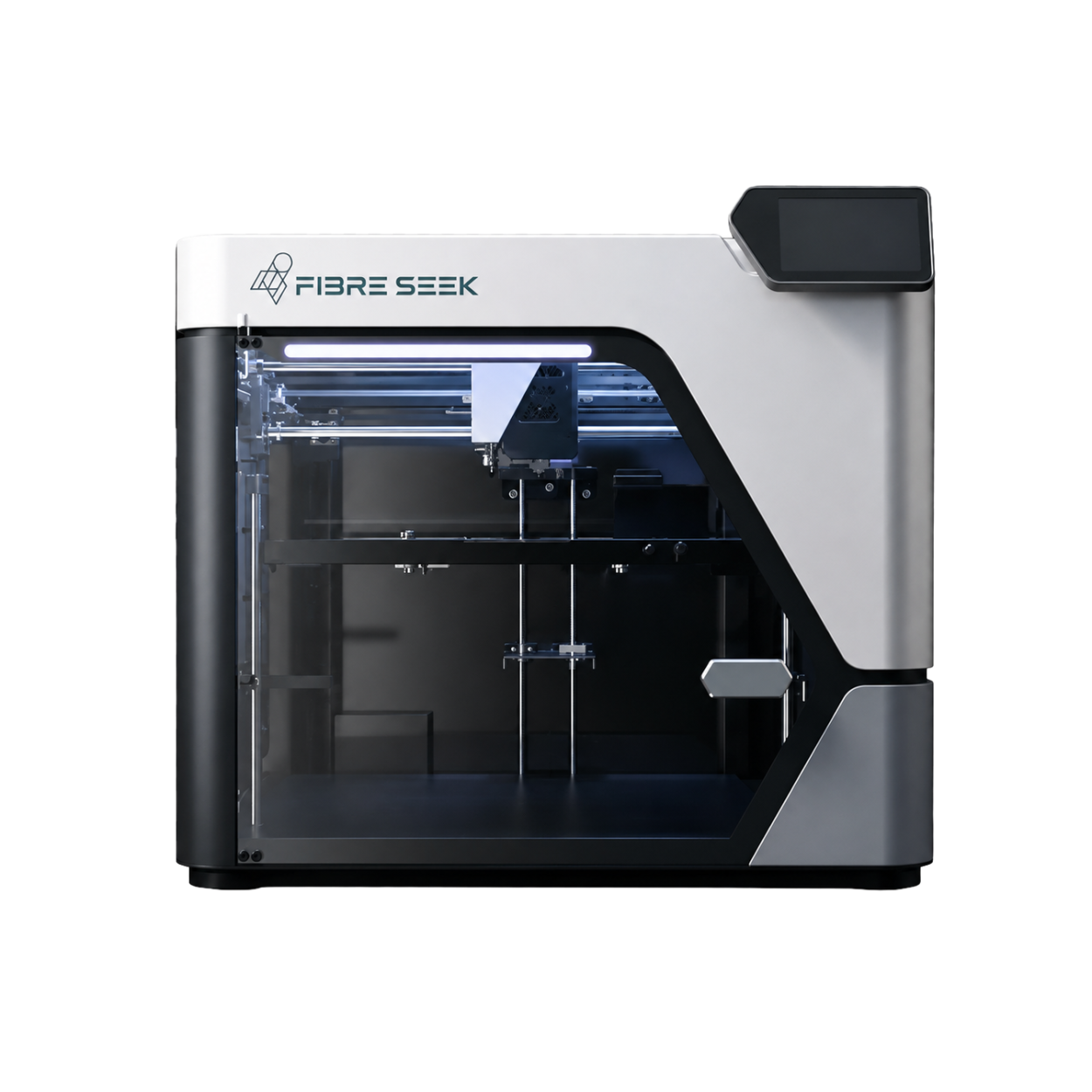
FibreSeeker 3 Continuous Fibre 3D Printer
The FibreSeeker 3 is a professional continuous fibre 3D printer for manufacturing, engineering and research applications. Its dual-nozzle system combines standard FFF printing with Composite Fibre Co-extrusion, placing continuous carbon or glass fibre inside thermoplastic parts to improve strength and stiffness.
FibreSeeker 3 Continuous Carbon Fibre 3D Printer
The FibreSeeker 3 is a new-generation continuous fibre 3D printer developed for engineering, manufacturing, tooling, product development and research. FibreSeek builds upon industrial continuous-fibre technology and engineering expertise developed by Anisoprint, re-engineering these capabilities into a more accessible desktop composite manufacturing platform.
By combining conventional Fused Filament Fabrication (FFF) with Composite Fibre Co-extrusion (CFC), the FibreSeeker 3 can embed continuous carbon or glass fibre reinforcement within thermoplastic components during printing. This allows reinforcement to be concentrated within selected areas of a component where additional stiffness or tensile performance is required.
With a 300 × 300 × 245 mm build volume, nozzle temperatures up to 350°C, a 65°C actively heated chamber, automatic bed levelling, integrated material monitoring and dedicated FFF+CFC slicing software, the FibreSeeker 3 brings continuous fibre composite 3D printing into a compact platform designed for professional desktop use.
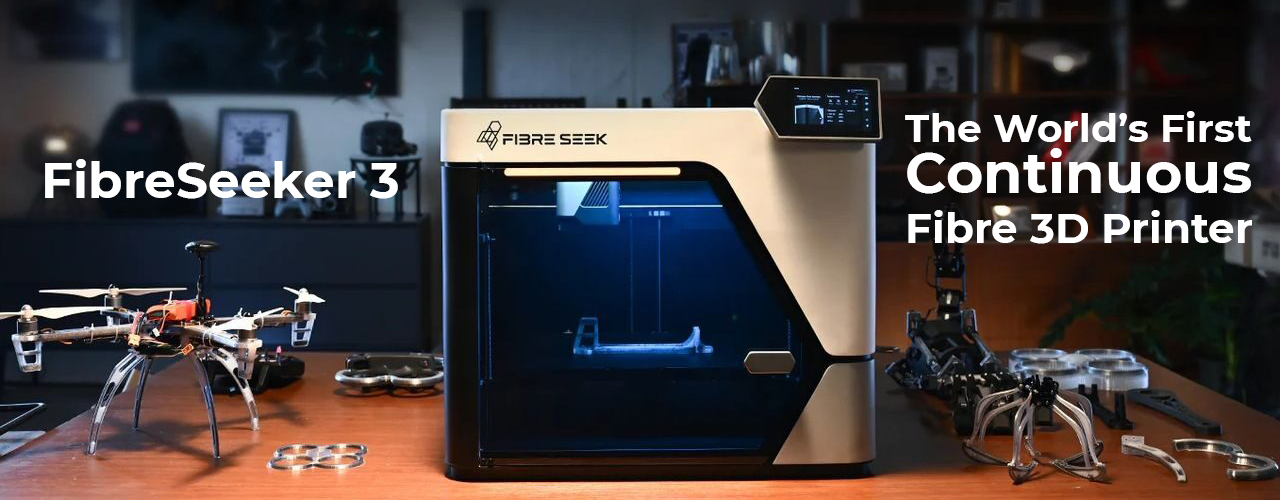
A Composite Alternative for Selected CNC-Machined Parts
Continuous fibre reinforcement can enable strong, lightweight engineering components for applications where conventional thermoplastic printing alone may not provide the required mechanical performance.
Continuous Fibre Composite Strength up to 900 MPa
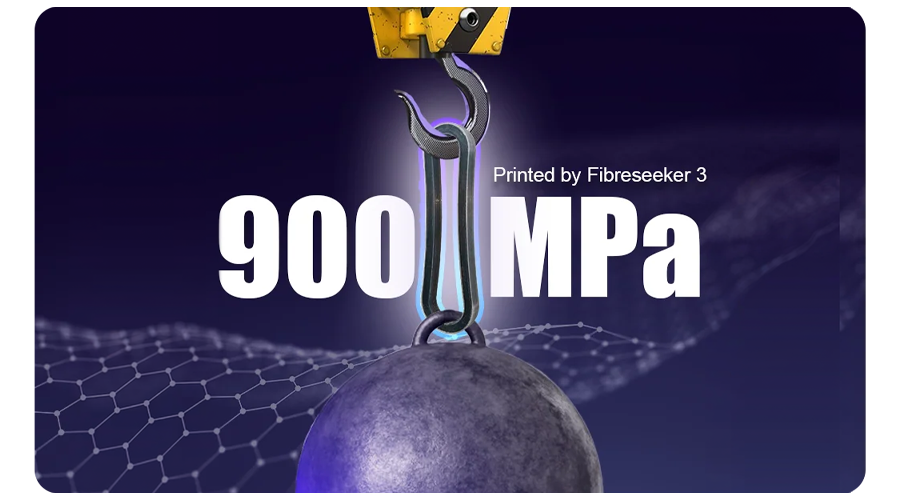
FibreSeek states that its continuous fibre system can produce composite structures with tensile strength reaching up to 900 MPa under suitable material, reinforcement and printing conditions. This creates opportunities to manufacture lightweight structural components, production fixtures, brackets, robotic tooling, UAV parts and other mechanically demanding components.
Continuous fibre reinforcement differs significantly from chopped carbon-fibre filament. Chopped-fibre materials contain short fibres distributed throughout the thermoplastic, while CFC printing places continuous strands of carbon or glass fibre through selected regions of the component. This enables reinforcement to follow defined load paths rather than relying solely on the properties of the base polymer.
Final component performance will depend on factors including matrix material, fibre type, fibre orientation, reinforcement density, geometry, print settings, environmental conditions and the direction and type of applied load.
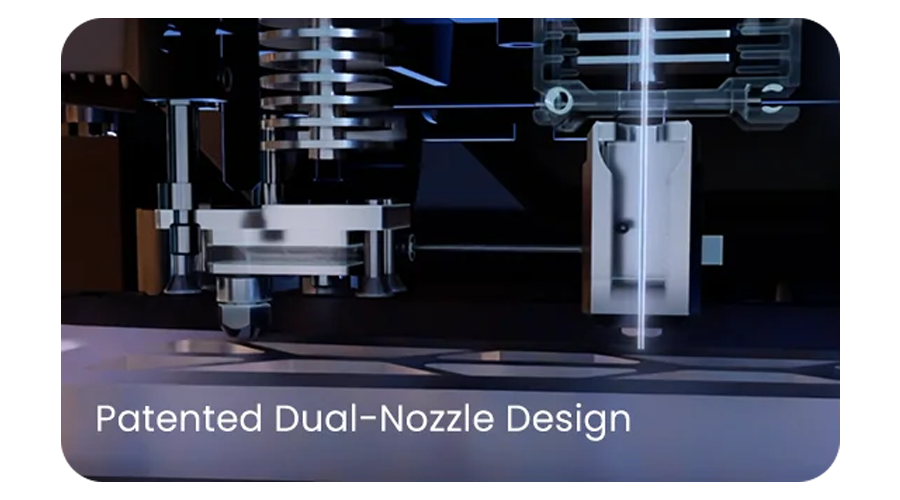
Dual-Nozzle CFC and FFF Extrusion System
The FibreSeeker 3 uses separate extrusion paths for conventional thermoplastic printing and continuous fibre reinforcement, allowing the two processes to be combined within the same component.
- 0.4 mm FFF Nozzle: Deposits the thermoplastic matrix, external walls, infill and conventional printed features at temperatures up to 350°C.
- 0.7 mm CFC Nozzle: Deposits the continuous fibre reinforcement used within composite components, with a maximum nozzle temperature of 350°C.
- Integrated Fibre Cutter: Controls where continuous reinforcement paths begin and end during the printing process.
- Hardened-Steel Nozzles: Designed for use with the supported engineering and composite material system.
This dual-process approach allows standard FFF geometry and continuous reinforcement to be prepared as part of the same composite manufacturing workflow.
Three Printing Modes for Prototyping and Composite Parts
The FibreSeeker 3 provides three printing modes for different production requirements:
- High Speed Mode: Uses the FFF nozzle for conventional thermoplastic printing and rapid prototypes.
- High Strength Mode: Combines FFF and CFC printing to introduce continuous fibre reinforcement within a thermoplastic component.
- Hyper Strength Mode: Prioritises continuous fibre deposition where a higher fibre content is required.
Supported FFF materials: PLA, PETG, polycarbonate (PC), nylon (PA), PA-CF/PACF and PET-GF/PETGF.
Continuous fibre materials: FibreSeek X-CCF continuous carbon fibre and X-CGF continuous glass fibre.
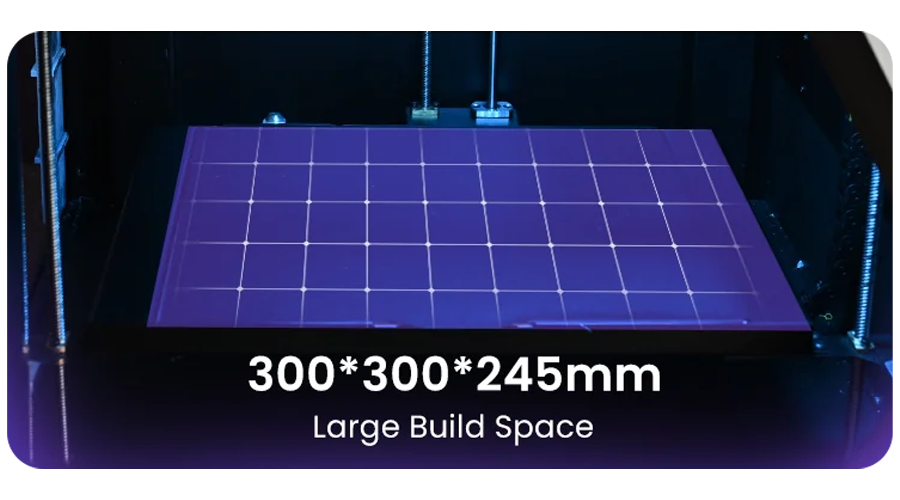
300 × 300 × 245 mm Build Volume
The 300 × 300 × 245 mm build volume provides space for sizeable engineering components, production fixtures and batches of smaller parts. This gives designers more freedom to produce functional components without automatically dividing larger designs into multiple printed sections.
A flexible high-temperature build plate supports straightforward part removal, while the heated bed reaches temperatures up to 110°C. Fully automatic bed levelling reduces manual setup and helps establish a consistent first layer across the available build area.
High-Speed FFF Printing up to 500 mm/s
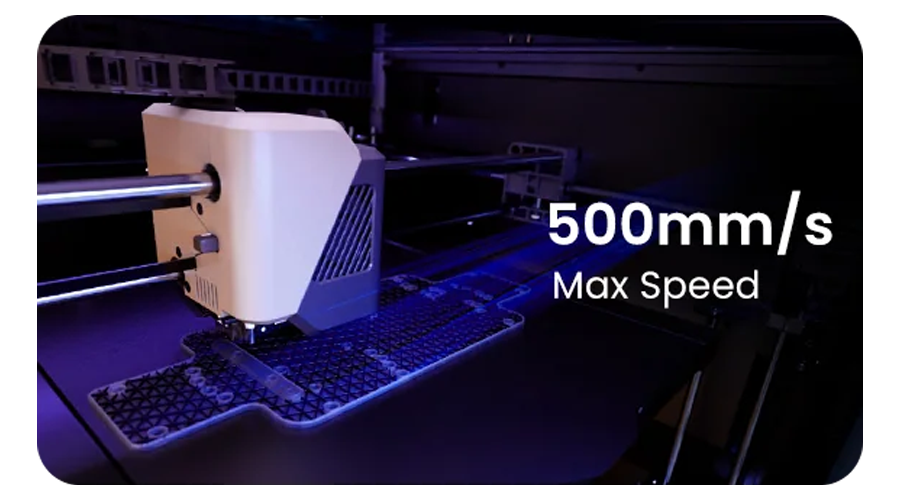
The FibreSeeker 3 provides a manufacturer-stated maximum FFF print speed of up to 500 mm/s, helping reduce production time when printing compatible materials and suitable geometries.
This makes it possible to use the same machine for rapid conventional FFF prototypes before progressing to continuous fibre reinforced versions of a design. When depositing continuous reinforcement, FibreSeek specifies a maximum CFC deposition rate of up to 20 cm³/h.
Actual printing and deposition speeds will vary according to the selected material, geometry, layer settings, reinforcement strategy and required print quality.
Dedicated FFF+CFC Slicing and Automatic Calibration
FibreSeek provides dedicated slicing software for preparing conventional thermoplastic toolpaths and continuous fibre reinforcement within the same workflow. The current FibreSeeker 3 specification lists FibreSeek Aura as its FFF+CFC slicer, with support for STL, STP and 3MF model formats on Windows and macOS.
The software allows users to prepare and preview the printing strategy for composite components, while the printer's automatic bed levelling and calibration functions reduce the amount of repetitive manual setup required before production.
These features are particularly useful in composite printing, where the relationship between the thermoplastic matrix and continuous reinforcement paths has a direct influence on the final component.

Integrated Camera and Material Monitoring
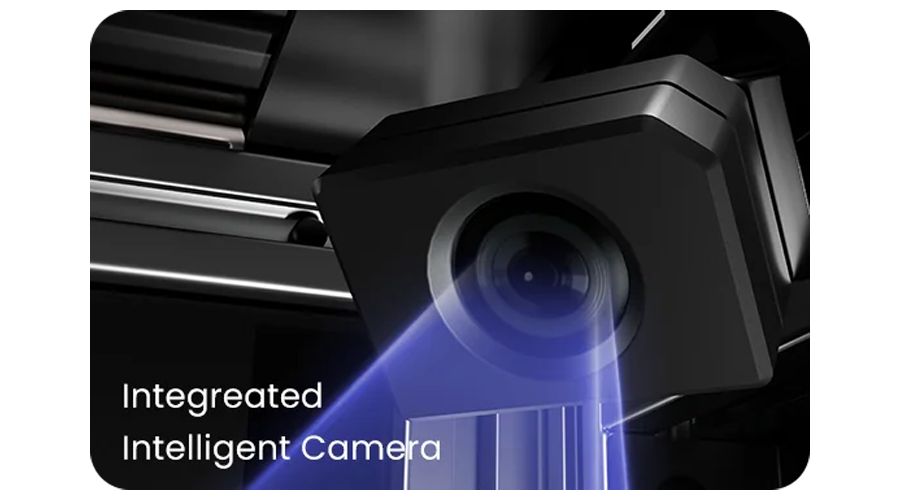
Composite engineering components can involve longer production cycles and a greater material investment than basic prototypes. The FibreSeeker 3 therefore includes a built-in 1280 × 720 live-view camera for visual print monitoring, together with a 5-inch colour touchscreen for local control.
The machine also includes dedicated detection for plastic breakage, plastic clogging, continuous fibre breakage and continuous fibre clogging. These monitoring systems are designed to provide greater visibility into both material paths during longer or more complex production jobs.
65°C Actively Heated Enclosed Build Chamber
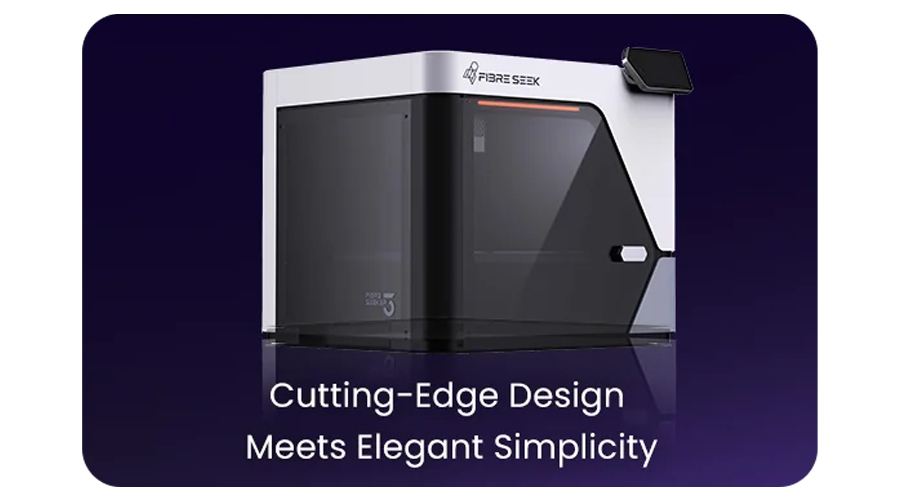
The FibreSeeker 3 packages its composite manufacturing system inside a compact plastic-and-glass enclosure suitable for professional workshops, engineering departments, research laboratories and educational environments.
An actively heated chamber reaches temperatures up to 65°C, helping maintain a more stable thermal environment when processing supported engineering thermoplastics such as nylon and polycarbonate. Greater thermal stability can help reduce the risk of dimensional changes, warping and internal stresses associated with temperature variation during printing.
The complete machine measures approximately 615 × 595 × 540 mm and weighs approximately 32 kg, providing continuous fibre capability within a desktop-format system.
Industrial Applications for FibreSeeker 3
Jigs, Fixtures and Tooling
Produce lightweight assembly fixtures, positioning jigs, drill guides, soft jaws and other production aids, potentially reducing reliance on outsourced machining for suitable applications.
Robotics and Automation
Manufacture reinforced end-of-arm tooling, sensor mounts, brackets and structural components where low moving mass, stiffness and customised geometry are important.
Functional and End-Use Parts
Create testable prototypes, replacement components and low-volume end-use parts with continuous reinforcement positioned according to the mechanical requirements of the design.
Frequently Asked Questions
How does Continuous Fibre Co-extrusion differ from chopped carbon-fibre filament?
Chopped carbon-fibre filaments contain short fibres distributed throughout the thermoplastic matrix. Composite Fibre Co-extrusion uses continuous reinforcement strands that can be positioned within selected areas of the component. This allows the fibre path and reinforcement strategy to form part of the structural design rather than relying only on short fibres dispersed through the plastic.
What materials can be used with the FibreSeeker 3?
FibreSeek lists PLA, PETG, PC, PA, PACF and PETGF as supported FFF materials. Continuous reinforcement is provided using FibreSeek X-CCF continuous carbon fibre and X-CGF continuous glass fibre. Material suitability and recommended settings should be checked for the specific application before production.
What is the connection between FibreSeek and Anisoprint?
FibreSeek states that it builds upon industrial continuous-fibre technology and aerospace engineering expertise developed by Anisoprint. FibreSeek has re-engineered these capabilities into its own desktop product platform, with the FibreSeeker 3 combining continuous fibre CFC printing with features including high-speed FFF printing, automatic levelling, active chamber heating and integrated monitoring.
Can FibreSeeker 3 parts replace CNC-machined aluminium components?
Continuous fibre composites may provide a lightweight alternative to selected machined components, but suitability must be assessed for each application. Mechanical performance depends on material selection, fibre direction, reinforcement density, part geometry, temperature, fatigue requirements and the loads applied to the finished component. Critical parts should be appropriately designed, tested and validated before use.
Performance figures shown are manufacturer-stated maximum or nominal specifications. Actual print speed, mechanical performance and finished-part properties depend on materials, geometry, fibre strategy, slicing parameters and operating conditions.
| Technical Specifications |
FibreSeeker 3 vs Anisoprint Composer A4The FibreSeeker 3 and Anisoprint Composer A4 are desktop continuous fibre 3D printers combining conventional Fused Filament Fabrication (FFF) with Composite Fibre Co-extrusion (CFC). FibreSeek builds upon continuous fibre technology and engineering expertise developed by Anisoprint, while introducing a larger build volume, higher FFF speeds, higher nozzle temperatures, active chamber heating, automatic levelling and integrated monitoring within a newer desktop platform.
Specifications are based on publicly available manufacturer information checked in September 2026. Continuous fibre printing speed is reported using different measurement methods by the two manufacturers: Anisoprint specifies linear CFC print speed in mm/s, while FibreSeek specifies volumetric deposition in cm³/h, so these figures should not be treated as a direct like-for-like speed comparison. Build capacity figures are calculated from the manufacturers' stated maximum build dimensions. Mechanical performance depends on material selection, fibre type, fibre orientation, reinforcement density, part geometry and printing conditions. Pricing shown reflects Daemon3DPrint website prices checked on 29 September 2026 and may change. |
|---|
What’s in the Box?
- 1 × FibreSeeker 3 continuous fibre 3D printer
- 1 × Plastic filament spool
- 1 × CFC plastic filament spool
- 1 × CFC 1K continuous fibre spool
- 1 × Quick-start guide
- 1 × Spare FFF nozzle
- 1 × Spare FFF hotend assembly
- 1 × PTFE tube
- 1 × Nozzle-cleaning needle
- 1 × Scraper
- 1 × Pair of tweezers
- 1 × Pair of diagonal pliers
- 1 × Hex key
- 1 × Screw set
- 1 × Solid build-plate adhesive
- 1 × Mechanical grease
- 1 × Thermal silicone grease
Please note that package contents may be updated by the manufacturer. Refer to your quotation or order confirmation for the exact items supplied.
What is continuous fibre 3D printing and how does the FibreSeeker 3 work?
The FibreSeeker 3 uses Composite Fibre Co-extrusion to place continuous carbon or glass fibre inside a thermoplastic part as it is printed. Unlike chopped-fibre filament, which contains short fibres mixed throughout the plastic, continuous reinforcement forms longer structural paths through the component. This can substantially improve strength and stiffness when the fibre is correctly positioned for the intended loading conditions.
How strong are parts printed with the FibreSeeker 3?
FibreSeek states that reinforced parts can achieve tensile strength of up to 900 MPa. Actual part strength depends on the base polymer, continuous fibre material, fibre orientation, reinforcement density, component geometry, print settings and direction of the applied load. Engineering validation and application-specific testing should therefore be completed before using a printed part in a safety-critical assembly.
What materials can the FibreSeeker 3 print?
The FibreSeeker 3 supports standard and engineering thermoplastics including PLA, PETG, polycarbonate, nylon, carbon-fibre-reinforced nylon and glass-fibre-reinforced PETG. Continuous reinforcement is produced using FibreSeek X-CCF continuous carbon fibre or X-CGF continuous glass fibre. Its dual-nozzle system allows thermoplastic and continuous fibre materials to be combined within the same component.
What manufacturing applications is the FibreSeeker 3 suitable for?
The FibreSeeker 3 is suitable for reinforced jigs, fixtures, tooling, robot components, UAV parts, structural brackets, replacement parts, functional prototypes and low-volume end-use components. It is particularly useful when a standard FFF part is not sufficiently stiff or strong, but machining the component from metal would be too expensive, heavy or time-consuming.
