OBC 3D Filament Explained: What Olefin Block Copolymer Is, Why It’s Used, and Where It Fits
OBC 3D Filament Explained: What Olefin Block Copolymer Is, Why It’s Used, and Where It Fits
If you’re looking into OBC filament, you’re probably not hunting for a pretty shelf model material. You’re looking for something more functional: lightweight, durable, chemically resistant, and able to handle repeated flex without turning into a floppy rubber part. That is the space OBC sits in. OBC stands for olefin block copolymer, and modern OBC materials are built around a distinct block architecture designed to deliver a useful balance of recovery, flexibility and processability. In 3D printing terms, materials such as Kexcelled K8 OBC are positioned around low water absorption, flexibility, chemical resistance and low density.
What Makes OBC Different?
What makes OBC interesting is that it does not behave like a typical rigid filament, but it also does not need to behave like a very soft TPU. OBC materials are designed with alternating hard, rigid blocks and soft, elastomeric blocks, which is what gives them that unusual mix of flexibility, elastic recovery and usable heat performance compared with more conventional polyolefin copolymers.
In plain English, that means OBC can bend, recover and absorb stress better than brittle filaments, while still keeping enough shape and structure to be useful for real parts.
Why Engineers May Choose OBC
That is why OBC makes sense for engineering readers who are trying to solve a specific problem rather than just print “something strong”. In real use, people are often trying to make parts that need to snap, flex, survive knocks, shrug off moisture, or keep working in environments where cleaners or chemicals are involved.
One of the more useful things about OBC is that it can be flexible when printed in thinner sections but behave more rigidly when designed with thicker walls or more substantial geometry. That means one printed part can include both a tougher body and a more flexible feature without changing material.
Typical Applications for OBC Filament
For 3D printing specifically, OBC is best thought of as a functional polyolefin elastomer. Its combination of low density, flexibility, chemical resistance and low moisture uptake makes it suitable for lightweight functional parts that need movement and resilience more than outright stiffness.
In practice, that makes OBC a sensible choice for living hinges, snap-close lids, flexible covers, chemical-resistant brackets, protective bumpers, cable guides, light-duty fixtures, and parts that may see repeated bending or damp conditions.
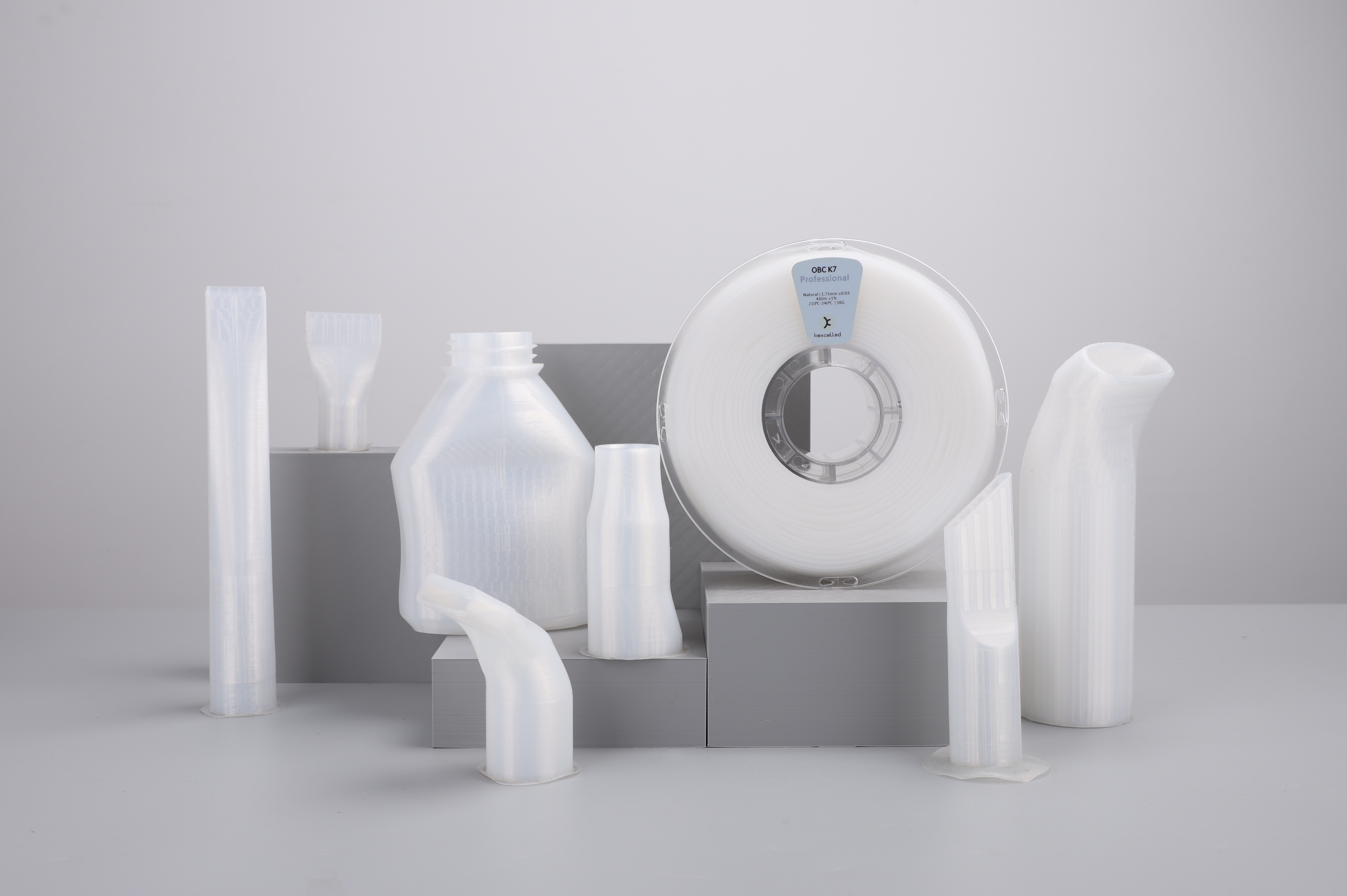
Printability and Hardware Requirements
One of the stronger arguments for OBC is that it brings those properties without demanding completely exotic hardware. K8 OBC is typically printed within a nozzle range of 210–250°C, with a bed range of 90–110°C, active cooling between 50–100%, and print speeds that can go far beyond many traditional flexible materials.
So while it is still an engineering filament and still benefits from a controlled setup, it is far more accessible than ultra-high-temperature materials that need specialist machines. In other words, OBC is not interesting because it is extreme. It is interesting because it delivers a very specific property mix on hardware many serious desktop users already have.
How It Compares to Softer Flexible Filaments
There is another reason engineers may like it: feed behaviour. One of the annoyances with very soft flexible filaments is that they can be awkward to push through some extruders, especially if the filament wants to buckle before it reaches the hot end.
OBC sits in a useful middle ground. It is rigid enough as a filament to be easier to extrude than many softer flexible materials, while still giving you flexibility in the finished part. That matters, because the best flexible engineering filament in the world is no good if it is a pain to run reliably.
Where OBC Has Its Limits
The important trade-off is heat. OBC is not a substitute for high-heat engineering materials. It is not the material for hot enclosures, parts sat against motors, or applications where temperature resistance is the main requirement.
OBC earns its place through flexibility, impact tolerance, low density, chemical resistance and low moisture uptake, not through extreme thermal performance. That distinction matters, because it helps people pick OBC for the jobs it is actually good at instead of expecting it to be a cheaper PC or a softer nylon.
Where OBC Fits Overall
So where does OBC fit overall? It sits in a very useful middle ground. It is more purpose-built than standard hobby filaments, easier to process than some soft flexibles, and better suited than brittle materials when the part needs to move, recover, or survive repeated use.
If your goal is a rigid display part, there are easier options. If your goal is a high-heat structural part, there are stronger options. But if your goal is a lightweight, chemically resistant, fatigue-tolerant engineering print that can flex without giving up completely, OBC starts to make a lot of sense. For the right design, that is exactly what people are trying to get out of it.
You can view the product here: Kexcelled THE K8 Olefin Block Copolymer (OBC) Filament – 1.75mm.